
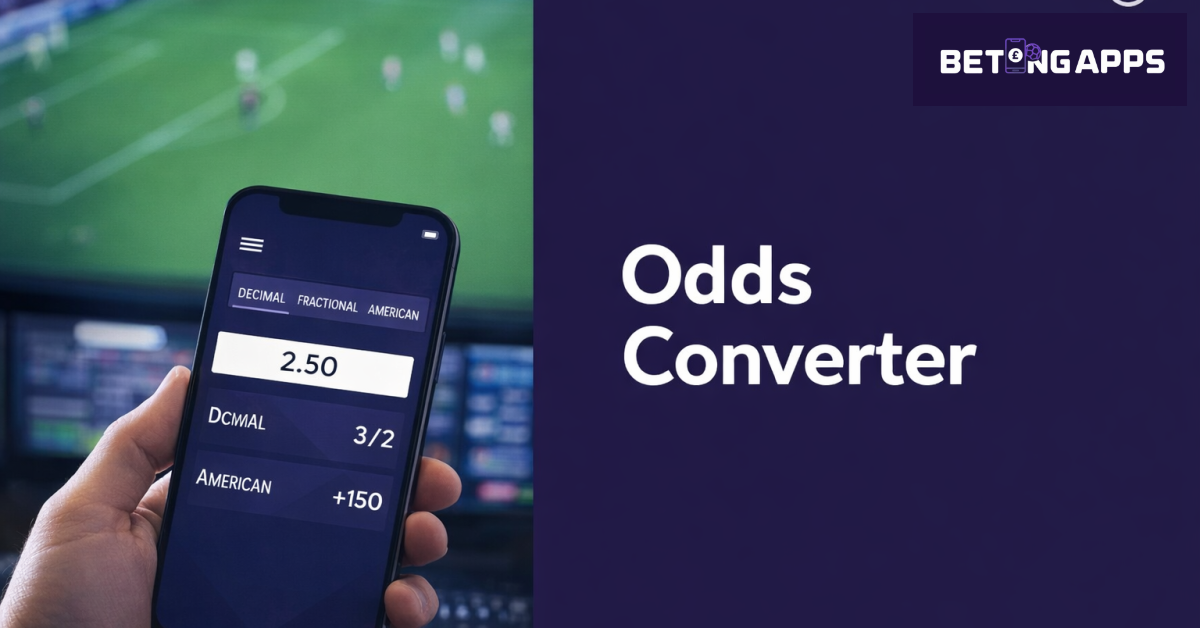
An odds converter translates betting odds between formats such as fractional, decimal, and American. Converting odds helps you compare prices across bookmakers, understand potential returns, and check the implied probability behind a market.
Odds formats present the same underlying price in different ways. Conversion avoids misreading value, especially when odds are close together or displayed with rounding
Odds Converter Tool
An odds converter tool takes one odds format as an input and outputs the equivalent in other formats. Using a converter reduces arithmetic errors and supports quicker comparisons between bookmakers and betting apps.
A converter also helps you move from odds to implied probability. That step matters for judging how likely an outcome is according to the price, before considering margins and market conditions.
How To Use The Odds Converter
Enter the odds in the format shown by the bookmaker, select the input format, then read the converted outputs. Check whether the tool uses rounding and whether it shows returns including or excluding stake.
Supported Odds Formats
Common converters support fractional, decimal, and American odds. Many tools also support Hong Kong, Indonesian, and Malaysian odds, which appear more often on Asian-facing bookmaker sites.
Implied Probability Explained
Implied probability is the percentage chance suggested by the odds. Implied probability equals the inverse of decimal odds, expressed as a percentage.
If you want to compare this converter with other betting app features and tools, check which options support rounding controls and implied probability outputs.
Odds Formats Explained
Each odds format expresses the same price using different conventions. Understanding how each format reads helps you spot input errors and interpret outputs, especially when a bookmaker uses unfamiliar Asian odds.
Odds formats also affect how returns are shown. Decimal odds show total return per unit staked, while fractional odds focus on profit relative to stake.
Fractional Odds
Fractional odds show profit relative to stake, written as A/B (for example, 5/2). A £10 stake at 5/2 returns £25 profit plus the £10 stake, for a £35 total return.
Decimal Odds
Decimal odds show total return per unit staked, including stake (for example, 3.50). A £10 stake at 3.50 returns £35 total, which includes £25 profit plus the £10 stake.
American Odds
American odds use plus and minus numbers. Positive odds (for example, +150) show profit on a 100-unit stake; negative odds (for example, -200) show the stake needed to win 100 units.
Hong Kong Odds
Hong Kong odds show profit per unit staked, excluding stake (for example, 0.75). A £10 stake at 0.75 returns £7.50 profit plus the £10 stake.
Indonesian Odds
Indonesian odds resemble American odds but use decimal-style values. Positive numbers show profit per unit stake; negative numbers show the stake required to win one unit.
Malaysian Odds
Malaysian odds combine features of Hong Kong and Indonesian formats. Positive values show profit per unit stake, while negative values show the stake needed to win one unit, typically within a -1.00 to 1.00 range.
Odds Conversion Examples
Worked examples help confirm the conversion logic and highlight where rounding changes the displayed price. Bookmakers often round to two decimals in decimal odds and may present simplified fractions, so exact matches are not always shown.
Use examples to sanity-check a converter, particularly when switching between fractional and American formats where errors are common.
Fractional To Decimal Example
Fractional 5/2 converts to decimal by adding 1 to the fraction result: (5 ÷ 2) + 1 = 3.50. A £10 stake at 3.50 returns £35 total.
Decimal To Fractional Example
Decimal 1.80 converts to fractional by subtracting 1 and expressing the remainder as a fraction: 1.80 – 1 = 0.80, which equals 4/5. Bookmakers may display 4/5 or an equivalent simplified fraction.
American To Decimal Example
American +150 converts to decimal as (150 ÷ 100) + 1 = 2.50. A £10 stake at 2.50 returns £25 total.
Decimal To American Example
Decimal 2.50 converts to American as (2.50 – 1) × 100 = +150. If decimal odds are below 2.00, the American result becomes negative rather than positive.
Implied Probability And Overround
Implied probability translates odds into a percentage, making outcomes easier to compare across markets. This is useful for checking whether a price looks short or long relative to alternatives, before considering bookmaker margins.
Overround measures the bookmaker’s built-in margin across all outcomes in a market. Overround affects how closely implied probabilities reflect a “fair” market.
How Implied Probability Relates To Odds
Decimal odds convert to implied probability using 1 ÷ decimal odds. Decimal 2.00 implies 50%, and decimal 1.50 implies 66.67%, subject to rounding.
What Overround Means For Betting Markets
Overround is the total of implied probabilities across all outcomes, minus 100%. A market totalling 105% indicates a 5% margin, which makes each outcome slightly shorter than a no-margin price.
Common Mistakes When Converting Odds
Conversion mistakes usually come from misreading the input format or misunderstanding whether stake is included in returns. These errors lead to incorrect comparisons and can distort implied probability checks.
Small display differences also matter. Two bookmakers can show different fractions for the same underlying decimal price because of rounding and fraction simplification.
Rounding And Display Differences
Bookmakers often round decimal odds to two places and present “neat” fractions. A conversion may look wrong if one site shows 0.83 as 5/6 while another shows 0.80 as 4/5.
Plus And Minus Signs In American Odds
American odds must keep the sign. +120 and -120 are different prices with different implied probabilities, so dropping the sign produces a large conversion error.
Stake And Returns Confusion
Decimal odds already include stake in the return figure, while fractional and Hong Kong formats typically highlight profit. Mixing “profit” and “total return” causes mismatched comparisons.
FAQs
What Are The Most Common Odds Formats In The UK?
UK bookmakers most commonly use fractional odds by default, with decimal odds widely available as a display setting. American odds appear less often in the UK but may be shown on some apps or for certain markets.
How Do You Convert Fractional Odds To Decimal Odds?
Fractional odds convert to decimal by dividing the fraction and adding 1. For A/B, the decimal odds equal (A ÷ B) + 1.
How Do You Convert Decimal Odds To Fractional Odds?
Decimal odds convert to fractional by subtracting 1, then expressing the remainder as a simplified fraction. For example, 1.75 becomes 0.75, which equals 3/4.
What Does Implied Probability Mean In Betting?
Implied probability is the chance of an outcome suggested by the odds. It is calculated from decimal odds as 1 ÷ decimal odds, then converted to a percentage.
Why Do Odds Differ Between Bookmakers?
Bookmakers use different margins, models, and risk management, which leads to different prices. Odds also move due to market demand, team news, and liquidity, so the same event can show varying odds across sites.
Conclusion
An odds converter supports accurate comparison between fractional, decimal, American, and selected Asian odds formats. Clear conversions also make it easier to interpret implied probability without mixing profit and total return.
Checking rounding, stake inclusion, and American signs avoids the most common errors. Consistent conversion habits reduce misunderstandings when switching between bookmakers and odds displays.

Joe Kizlauskas is an experienced iGaming writer with over a decade of industry experience covering betting apps, bookmakers, and online gambling products in the UK market. His work focuses on how betting apps operate in practice, including market coverage, app performance, payments, and regulatory standards.
Alongside his professional background in iGaming, Joe has extensive first hand exposure to the sports covered on this site. He played football for more than 30 years and has regularly attended horse racing events, giving him a practical understanding of how betting markets relate to real sporting contexts.
This combination of industry knowledge and sporting experience informs the analysis on BettingApps.uk.com. All content is written with a focus on clarity, accuracy, and UK regulation, ensuring comparisons are grounded in how betting apps function rather than promotional claims.