
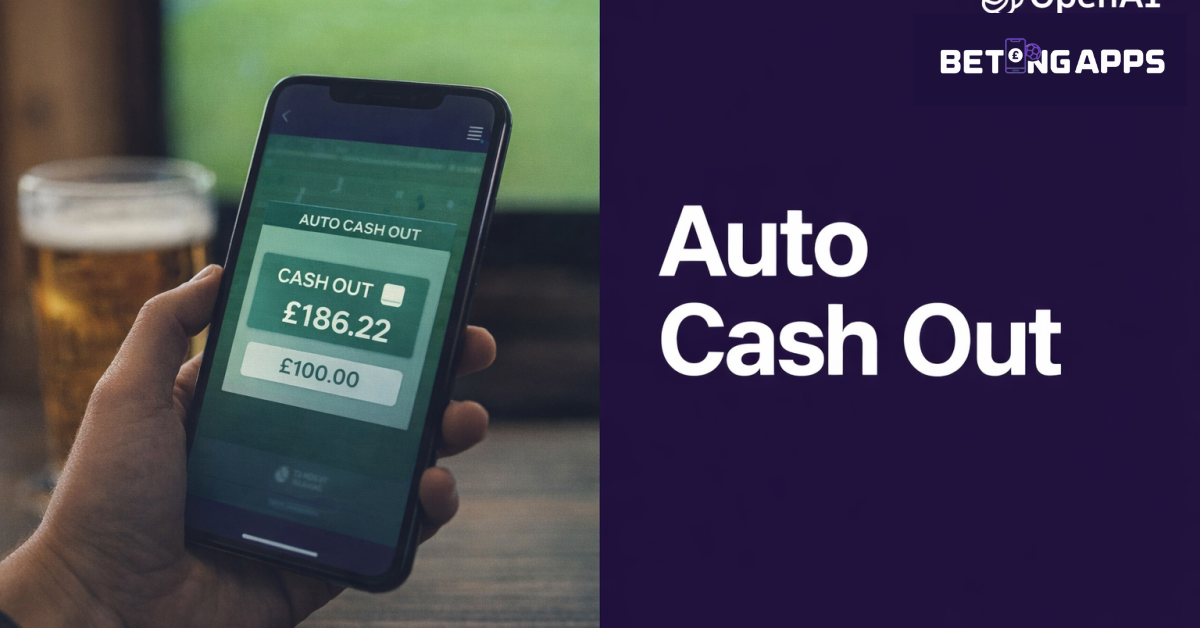
Auto cash out is a betting feature that sets an automatic exit point for a bet at a chosen price or return level. Auto cash out applies mainly to sports where the bookmaker offers cash out, and it only takes effect when the relevant cash out market is available.
Auto cash out changes how a cash out decision happens during an event. Auto cash out settings affect timing, potential returns, and exposure to price movements, and they do not remove the risk of loss or guarantee execution at the selected level.
Auto Cash Out Explained
Auto cash out is a betting feature that closes an eligible cash out bet automatically when a pre-set cash out value is reached. Auto cash out uses the bookmaker’s cash out offer at that moment, so the final settlement reflects the live cash out price, not a guaranteed return. Auto cash out only applies where cash out is available and the bookmaker accepts the cash out request.
Auto cash out matters for managing risk and protecting a return without needing to monitor a match continuously. Auto cash out also adds limits and dependencies, including cash out availability, market suspension, and changes in cash out pricing during in-play trading.
What Auto Cash Out Means In Betting
Auto cash out is an instruction added to a bet that triggers a cash out attempt once the bookmaker’s displayed cash out value reaches a chosen amount. Auto cash out works by monitoring the cash out figure and sending a cash out request when the trigger level is met.
Auto cash out does not change the underlying bet terms. A cash out remains an offer from the bookmaker, so auto cash out does not guarantee execution at the trigger value. Bookmakers suspend markets during key moments, and cash out often becomes unavailable during suspensions. Price movements also cause the cash out value to jump past the trigger level, so the accepted cash out value differs from the trigger.
Auto cash out typically supports one or both of the following trigger types:
- Take profit: Cash out when the cash out value rises to a chosen return.
- Stop loss: Cash out when the cash out value falls to a chosen return.
Auto cash out therefore functions as automation for an existing cash out feature, rather than a separate bet type.
Where Auto Cash Out Appears (Pre-Match, In-Play, Cash Out, Bet Builder)
Pre-match markets often show auto cash out as an option after placing an eligible bet, once the bookmaker publishes a cash out value for that selection. Availability varies by sport, market, and operator, and some bets only become cash out eligible after the event starts.
In-play betting introduces extra volatility because cash out values react to live events and frequent market suspensions. Auto cash out in-play therefore depends more heavily on uninterrupted cash out availability and stable market pricing. A suspension at the trigger point prevents an immediate cash out attempt, and the cash out value often reopens at a different level.
Cash out screens usually host the controls for setting, editing, or cancelling auto cash out. Bookmakers often restrict editing after kick-off or after certain match events, and some operators require confirmation steps that affect timing. Auto cash out also stops applying once a bet is partially cashed out or fully settled.
Bet Builder cash out varies the most because the bookmaker prices multiple legs together. Some Bet Builder bets support cash out and auto cash out, while others do not, depending on the sport and leg types. Correlated selections and certain player markets commonly reduce cash out availability, which also removes auto cash out eligibility. Auto cash out therefore appears most reliably on standard singles and selected accumulators where the operator offers consistent cash out pricing.
How Auto Cash Out Works
Auto Cash Out is a bookmaker feature that places a cash out instruction on an open bet. The instruction aims to accept a cash out offer automatically when the offer reaches a value you set. Auto Cash Out depends on live cash out pricing, which changes with the event and the bookmaker’s risk controls.
Auto Cash Out settings differ by operator and by sport. Common differences include whether Auto Cash Out is available on a specific market, whether it stays active after a price change, and whether the bookmaker applies restrictions during suspensions. Auto Cash Out only applies while cash out is available for the bet.
Setting A Trigger Price Or Amount
A trigger sets the cash out value that activates the instruction. Auto Cash Out usually supports one of two trigger types: a target cash out amount in pounds, or a target cash out return based on the offer shown in the betting app.
A trigger amount links to the cash out offer, not the original odds. The cash out offer changes as the underlying probability changes, so the trigger may activate sooner or later than expected. Bookmakers also apply minimum and maximum cash out thresholds, which affect whether a trigger value is accepted.
Timing, Suspension, And Market Changes
Auto Cash Out activates only when cash out pricing is live and the market is open. Suspensions stop price updates, which pauses Auto Cash Out until the market reopens. Common suspension points include goals, penalties, red cards, tries, and VAR checks.
Bookmakers also reprice markets when key information changes. A repricing event can move the cash out offer past the trigger between updates. Some operators treat a trigger as “at or above” the set amount, while others require the offer to match the trigger exactly. Auto Cash Out also fails if cash out is removed from the bet before the trigger condition is met.
Partial Cash Out And Multiple Selection Bets
Partial cash out splits an open bet into two parts: a settled part that locks in the accepted offer, and an active part that stays on the event. Auto Cash Out may support partial cash out, but some bookmakers restrict Auto Cash Out to full cash out only. A partial instruction also depends on minimum stake and minimum cash out rules.
Multiple selection bets such as accumulators use a single cash out offer for the combined outcome. A change in one leg changes the overall cash out price, so Auto Cash Out triggers can move quickly during live legs. Some operators remove cash out on multiples when one selection settles, when a market suspends, or when a leg changes to a restricted status, which limits when Auto Cash Out applies.
Auto Cash Out Vs Manual Cash Out
Auto Cash Out and manual Cash Out both close a Cash Out eligible bet before the event ends, but they operate in different ways. Auto Cash Out uses a pre-set trigger value to request a Cash Out automatically, while manual Cash Out requires you to choose the time and accept the price shown in the app or on the site.
Auto cash out applies mainly to sports where the bookmaker offers cash out betting apps, and it only takes effect when the relevant cash out market is available.
The differences affect speed, control, and the final return. Bookmakers also apply the same underlying limits to both features, including market eligibility, price changes, and event suspensions.
Control And Speed Differences
Manual Cash Out gives you direct control over timing. Manual Cash Out works by letting you tap Cash Out when the offer suits you, then confirm the amount shown. The bookmaker updates the offer frequently, so the figure may change between viewing and confirming.
Auto Cash Out prioritises speed of action over timing control. Auto Cash Out works by sending a Cash Out request when the offer reaches your chosen amount, but the bookmaker still needs to accept the request at the current available price. Auto Cash Out does not lock a return at the exact trigger value if the offer moves before the request processes.
Key practical differences include:
- Manual Cash Out gives you full timing control but needs you to act quickly.
- Auto Cash Out acts without further input but only around the trigger you set.
- Both methods depend on the bookmaker’s live price and any market suspension at that moment.
Manual Cash Out suits situations where the price is moving and you want to react to match events, such as a goal, a red card, or a late comeback. Auto Cash Out suits situations where you want a predefined exit point without monitoring the match continuously.
Common Scenarios Where Outcomes Differ
Price movement creates the most visible difference between Auto Cash Out and manual Cash Out. Manual Cash Out often produces different outcomes because the offer you accept depends on the exact second you confirm. Auto Cash Out often produces different outcomes because the request triggers and processes during fast-changing in-play pricing.
Common outcome differences occur in these scenarios:
- A goal or penalty triggers a temporary market suspension, so Auto Cash Out does not process at the trigger value.
- The Cash Out offer reaches the trigger briefly, then drops before the bookmaker processes the Auto Cash Out request.
- Manual Cash Out is delayed because you need to log in, load the bet, and confirm, so the offer changes before acceptance.
- A match incident changes the price rapidly, so manual Cash Out secures a return that Auto Cash Out misses, or the reverse.
Bookmakers also apply different confirmation steps. Manual Cash Out often needs an explicit confirmation, while Auto Cash Out relies on the pre-set instruction and then uses the next available offer when processing resumes.
When Auto Cash Out Does Not Apply
Auto Cash Out does not apply if the bookmaker does not offer Cash Out on the bet at that time. Cash Out eligibility varies by operator and by market, and it also changes during an event due to suspensions and trading rules.
Auto Cash Out commonly does not apply in these cases:
- The bet type is not Cash Out eligible, such as some specials, certain accumulators, or selected boosted bets, depending on the bookmaker.
- The market is suspended during a key incident, such as a goal check, a red card review, or a VAR decision.
- The event ends, settles, or reaches a stage where the bookmaker removes Cash Out for that market.
- The bookmaker withdraws Cash Out temporarily due to pricing, liquidity, or integrity controls.
- The account or bet has restrictions that remove Cash Out, such as a voided selection or a regraded market.
Auto Cash Out also stops applying if the trigger condition cannot be met, such as setting a value above the maximum Cash Out offer during the match. Both Auto Cash Out and manual Cash Out remain subject to the bookmaker’s live pricing and suspension rules at the moment of action.
Key Terms And Calculations
Auto Cash Out uses the bookmaker’s live Cash Out price, so the key numbers are the same as manual Cash Out. Understanding the core terms helps you judge whether a trigger level is realistic and what the Cash Out figure represents.
Cash Out values change as markets move, because odds, time remaining, and new information affect the implied chance of the selection winning. The figures displayed by the bookmaker also reflect margin and any commission rules that apply to the bet type.
Cash Out Value And Implied Probability
Cash Out value is the amount the bookmaker offers to settle the bet early. The bookmaker sets the Cash Out price from current odds and internal adjustments, so the offer does not equal a simple “fair” calculation in most cases.
Implied probability converts odds into a percentage chance. Auto Cash Out trigger points often make more sense when mapped to implied probability, because the Cash Out offer typically rises as the implied probability of winning increases.
- Decimal odds implied probability: Implied Probability = 1 ÷ Decimal Odds
- Fractional odds implied probability: Implied Probability = Denominator ÷ (Numerator + Denominator)
A Cash Out offer usually increases when decimal odds shorten and decreases when decimal odds drift. Suspension periods, such as during key moments in-play, remove the ability to Cash Out until the market reopens, so Auto Cash Out does not execute during suspension.
Commission, Margin, And Price Movements
Bookmaker margin (often called the overround) is the built-in edge within the odds. Margin affects both the live odds and the Cash Out offer, because the Cash Out price reflects the bookmaker’s current trading position rather than a neutral market.
Commission applies mainly to betting exchanges rather than standard bookmaker sports betting. Where commission applies, the net return reduces after the outcome settles, which also affects the value of holding a position versus closing it early.
Price movements happen because new information changes the market view of probability. Common drivers include team news, injuries, red cards, a goal, weather changes, and market liquidity. A drifting price usually reduces the Cash Out offer, while a shortening price usually increases the Cash Out offer, subject to the bookmaker’s margin and any in-play restrictions.
Payout, Stake Return, And Profit Figures
Payout is the total amount returned if the bet settles as a winner. Stake return is the original stake included within the payout. Profit is the amount above the stake.
- Payout (Decimal Odds) = Stake × Decimal Odds
- Profit (Decimal Odds) = Stake × (Decimal Odds − 1)
- Stake Return = Stake
- Cash Out Profit or Loss = Cash Out Value − Stake (before any relevant deductions)
Auto Cash Out triggers based on the Cash Out value offered at that moment, not on the theoretical payout at the current odds. These definitions and calculations help you compare a Cash Out offer against the remaining upside and downside of leaving the bet to run.
Benefits And Limitations Of Auto Cash Out
Auto Cash Out sets a predefined cash out trigger on an eligible bet, then submits a cash out request if the operator offers a matching cash out price at that moment. Auto Cash Out affects settlement value and timing, so it directly links to risk control and trade-offs between certainty and upside.
Auto Cash Out behaviour depends on price movement, liquidity, and operator availability. Auto Cash Out does not guarantee a cash out, and operator rules and technical conditions decide whether a trigger results in an executed cash out.
What Auto Cash Out Helps You Do
Auto Cash Out helps you apply a consistent exit point without needing to watch the match or market continuously. Auto Cash Out also supports faster decisions during sharp price movements, where manual cash out timing often becomes impractical.
Auto Cash Out supports common cash out objectives, including:
- Limiting losses by setting a minimum acceptable cash out value.
- Locking in profit by setting a target cash out value.
- Managing exposure across multiple live bets by reducing manual monitoring.
Auto Cash Out still relies on the operator offering a cash out price when the trigger is reached, so the benefit is strongest on markets with stable liquidity and frequent price updates.
Risks Of Relying On Automation
Auto Cash Out increases the risk of exiting at a worse time than a manual decision when a short-term price spike triggers the threshold and the market later moves back in your favour. Auto Cash Out also reduces flexibility, because the trigger typically acts on a single value rather than wider match context such as momentum changes, injuries, or tactical shifts.
Auto Cash Out also creates execution risk. Auto Cash Out triggers a request, but the actual cash out price may change between trigger and acceptance, especially during volatile in-play periods.
Auto Cash Out reliance carries specific practical risks:
- A cash out trigger does not execute if cash out is suspended.
- A cash out executes at a different value if the operator re-prices during processing.
- A cash out executes earlier than intended if the trigger value is met briefly.
- A cash out does not trigger at all if the operator restricts Auto Cash Out to selected markets or bet types.
Auto Cash Out works best as a defined rule for a defined scenario, rather than a substitute for understanding how cash out pricing changes in-play.
Operator Rules That Change Outcomes
Operator eligibility rules decide whether Auto Cash Out appears for a bet. Operator restrictions often vary by sport, market, and bet type, and some operators exclude bet builders, certain accumulators, or bets with free bet stakes from Auto Cash Out.
Operator cash out controls also change outcomes in-play. Operator trading teams suspend cash out around key events such as goals, penalties, red cards, VAR reviews, and the final minutes, which prevents an Auto Cash Out trigger from executing during those windows.
Operator technical and account rules also apply. Operator terms may state that cash out is subject to availability, and the operator decides whether to offer a cash out price at any time. Operator rules therefore determine the practical reliability of Auto Cash Out on specific bets.
Eligibility And Restrictions At UK Bookmakers
UK bookmakers apply eligibility rules to Auto Cash Out to manage risk and meet regulatory duties. Access usually depends on account status, identity checks, and whether the selection sits within supported markets, competitions, and bet types.
Auto Cash Out also carries stake and payout limits that differ by operator and market. Checking these restrictions before placing a bet reduces the risk of placing a bet that cannot use Auto Cash Out when the price moves.
Account Status, Verification, And Location Checks
Bookmaker accounts require an active status for Auto Cash Out to appear as an option on eligible bets. Bookmakers remove access for suspended or restricted accounts, and some operators limit features if safer gambling limits or trading restrictions apply to the account.
Identity verification affects feature access. UK-licensed operators run Know Your Customer and age checks, and incomplete verification blocks certain functions on some sites, including cash out tools. Payment method checks also trigger verification steps that delay access to feature settings.
Location checks apply because UK bookmakers use geolocation and IP checks to enforce licensing and fraud controls. Auto Cash Out may not display if the account logs in from a jurisdiction where the operator does not offer services, or if location data conflicts with account details. This keeps feature access aligned with the operator’s permitted territories.
Market Availability And Event Types
Auto Cash Out availability depends on the market and how the bookmaker prices it. Bookmakers typically support Auto Cash Out on higher-liquidity pre-match markets, where live pricing updates regularly and the operator manages exposure more predictably.
In-play events often carry tighter restrictions. Fast-moving markets, suspended periods, and delayed feeds reduce the reliability of an automatic trigger, so bookmakers exclude some in-play sports, leagues, or bet builders from Auto Cash Out. Event interruptions, voided legs, or abandoned matches also prevent Auto Cash Out from settling as expected, so operators limit the feature around these scenarios.
Auto Cash Out also depends on whether the bookmaker offers standard manual cash out on the selection. If a market does not qualify for cash out pricing, Auto Cash Out does not apply to that bet.
Minimum Stakes, Maximum Returns, And Bet Types Excluded
Bookmakers set minimum stake thresholds and maximum payout caps for Auto Cash Out to control operational and trading risk. Some operators only enable Auto Cash Out above a stated stake level, and some cap the cash out amount even when the potential return exceeds the cap.
Certain bet types exclude Auto Cash Out by default. Common exclusions include:
- Free bets and bonus stakes, depending on operator terms
- Each-way bets on selected sports or markets
- Complex multiples, including some accumulators, bet builders, and system bets
- Bets with manually edited odds, price boosts, or enhanced odds offers
- Bets placed after a market change, such as rule 4 deductions or late withdrawals
Price movement also affects eligibility in practice. Auto Cash Out triggers only when the bookmaker offers a cash out price at or above the set target, and a suspended market blocks execution until pricing resumes. Eligibility therefore depends on both the bet rules and the availability of a live cash out quote at the trigger point.
Common Reasons Auto Cash Out Fails
Auto Cash Out fails when the bookmaker cannot execute the requested cash-out price at the moment the trigger hits. Execution depends on live pricing, market status, and the app’s ability to send and confirm the instruction in time. Understanding typical failure points helps you judge when Auto Cash Out offers reliable protection and when it adds limited value.
Bookmaker rules also affect execution. Some operators treat Auto Cash Out as an instruction to attempt a cash out, not a guarantee of settlement at a specific amount, especially during fast-changing in-play periods.
Market Suspension And Volatility
Market suspension blocks cash out because the operator stops pricing temporarily. Operators suspend markets during key events such as goals, red cards, penalties, VAR checks, injuries, and official reviews. Auto Cash Out cannot place a cash-out request while the market is suspended, so the trigger may be missed or rejected.
Price volatility causes failure when the cash-out value moves faster than the operator can confirm the trade. In-play odds update rapidly, and the cash-out figure can change between the trigger moment and the operator’s confirmation. Auto Cash Out fails if the price is no longer available or if the operator applies a tolerance rule that rejects the request outside an acceptable range.
Technical Issues And App Connectivity
Connectivity issues interrupt Auto Cash Out because the app needs a stable connection to send the request and receive confirmation. Mobile signal drops, Wi‑Fi switching, background data restrictions, and power-saving modes can delay requests at the exact time the trigger hits.
Operator-side technical problems also prevent execution. App outages, slow servers, delayed price feeds, and account session timeouts can stop Auto Cash Out from processing. A successful trigger usually requires the bet to remain eligible for cash out and the account to stay logged in with an active session.
Trading Decisions And Manual Overrides
Eligibility changes stop Auto Cash Out when the operator removes cash out from a market or a specific bet type. Some selections lose cash-out access after partial settlement, rule changes in-play, or when the operator limits cash out on certain markets. Auto Cash Out fails if cash out is not offered at the time of the trigger.
Manual actions override automation on many betting apps. A manual cash out, partial cash out, editing the Auto Cash Out target, placing related bets, or changing the bet state can cancel the existing Auto Cash Out instruction. Auto Cash Out also fails if the target is set unrealistically close to the current price during volatile periods, because the operator may not confirm the amount before it moves.
Practical Checks Before Using Auto Cash Out
Auto cash out settings affect when a bookmaker attempts to settle a bet early, so small differences in triggers and timing change the return and the exposure left on the market. Auto cash out also interacts with live pricing, market suspension, and operator rules, so the same trigger does not produce the same outcome on every event.
Bookmaker cash out terms set the boundaries for when auto cash out applies and when it fails to execute. Checking the trigger logic, the guarantee position, and the record trail reduces avoidable disputes and helps confirm whether the feature behaves as expected for the bet type used.
Setting Realistic Triggers
Auto cash out works by placing an instruction to cash out when the cash out value reaches a chosen level. A realistic trigger reflects normal price movement for the market and the time left in the event, rather than aiming for a value that rarely appears.
A few practical checks support sensible trigger levels:
- Check whether the trigger uses a cash out value, a profit figure, or a return figure, because the same number means different outcomes.
- Check whether the trigger applies to partial cash out or full cash out only, because partial settlement changes remaining exposure.
- Check whether the bookmaker uses minimum increments or rounds cash out values, because rounding affects exact trigger points.
- Check whether the trigger remains active after odds changes, a market switch, or an app restart, because persistence varies by operator.
A trigger that sits close to the current cash out value is more likely to execute quickly, but it also increases the chance of cashing out on short-term volatility rather than a sustained move.
Understanding Cash Out Not Being Guaranteed
Cash out, including auto cash out, is not guaranteed because the bookmaker controls availability and the market price can change faster than the instruction executes. Operator rules also limit cash out during suspensions and at key moments such as goals, red cards, penalties, try reviews, or other in-play incidents.
Auto cash out often fails to execute for common operational reasons:
- Market suspension blocks cash out during in-play incidents or when a feed pauses.
- Price movement causes the cash out value to skip past the trigger without an executable price at that moment.
- Cash out withdrawal by the bookmaker removes the option for specific markets, selections, or bet types.
- Technical issues such as app connectivity, account restrictions, or service outages interrupt execution.
A matched cash out trigger does not guarantee settlement, so the bet remains live until a cash out completes or the market settles normally.
Keeping Records Of Settings And Bet History
Auto cash out relies on settings that change over time, so keeping records helps confirm what instruction was active for each bet. A clear record also supports a complaint or query if a cash out instruction does not behave as expected.
Key items to capture include:
- The exact trigger value and whether the instruction targets profit, return, or cash out amount.
- The time and date the setting is applied or edited.
- The bet reference, market, and stake details from bet history.
- The cash out availability status around the time the trigger is reached, where the bookmaker displays it.
Accurate records link the auto cash out setting to the bet outcome and support a clearer assessment of how the feature performs under the operator’s rules.
Responsible Gambling Considerations
Auto Cash Out changes how a bet gets settled, but it does not reduce the underlying risk of losing money. Responsible gambling controls matter because Auto Cash Out settings can create frequent bet settlements, which affects spending pace and decision-making during live betting.
UK-licensed bookmakers provide account tools that support spending control and time management. Auto Cash Out works best alongside these tools, because limits and safer gambling checks apply across the full account, not only to bets using Cash Out.
Bankroll Controls And Deposit Limits
Bankroll controls set clear boundaries for how much money goes into betting, how much stays in play, and when betting stops for the day or week. Deposit limits reduce the risk of increasing stakes during a session, because the account cannot receive extra funds beyond the limit.
Common controls on UK bookmaker accounts include:
- Deposit limits (daily, weekly, or monthly)
- Loss limits
- Wager or stake limits
- Time-out or cooling-off periods
- Session reminders and reality checks
Auto Cash Out settings work alongside these controls, but they do not replace them. A deposit limit and a pre-set maximum stake keep Auto Cash Out use consistent with an affordable budget.
Avoiding Chasing Losses With Cash Out Features
Chasing losses happens when stakes increase after losses to try to recover money quickly. Cash Out features add extra decision points during an event, which increases the chance of reacting to short-term outcomes rather than following a planned approach.
Practical checks that reduce loss-chasing behaviour include:
- Setting a maximum stake per bet before placing any in-play wager
- Avoiding re-betting immediately after an Auto Cash Out triggers
- Keeping Auto Cash Out thresholds consistent rather than adjusting them after each loss
- Stopping betting after reaching a pre-set loss limit for the day
Auto Cash Out settles a position early, but the next bet still carries full risk. A clear stop point protects against turning frequent settlements into repeated re-entry during the same match.
Support Options In The UK
UK support options include operator tools and independent services. UK-licensed bookmakers provide safer gambling features and account restrictions, and they also signpost to specialist support.
Support and protection options used by UK bettors include:
- GAMSTOP (self-exclusion from participating UK-licensed online operators)
- GamCare (information, support, and treatment services)
- National Gambling Helpline (confidential support and signposting)
If Auto Cash Out use starts to feel difficult to control, account limits and time-outs provide immediate friction, and specialist support provides structured help.
FAQs
Auto Cash Out is a bookmaker feature that places an automatic cash out request when a cash out value reaches a price you set. Availability, eligible markets, and settlement rules vary by operator, so the same settings do not always behave the same way across betting apps and sites.
Auto Cash Out uses live prices, so the final outcome depends on in-play price movement, market suspensions, and the bookmaker’s cash out rules. The FAQs below cover common reasons Auto Cash Out triggers, fails to trigger, or triggers at a different value than expected.
What Is Auto Cash Out In Sports Betting?
Auto Cash Out in sports betting is a cash out setting that triggers a cash out request automatically when the bookmaker’s offered cash out value reaches your chosen target. The target is usually set as a cash out amount rather than a decimal odds price.
Auto Cash Out only applies if the bookmaker offers cash out on that bet and continues to quote a cash out value during the event. The bookmaker calculates the cash out offer using live prices, margin, and any relevant market rules.
Is Auto Cash Out Guaranteed Once Set?
Auto Cash Out is not guaranteed once set. Auto Cash Out depends on the bookmaker still offering cash out at the moment the target is reached and the market remaining available to trade.
Bookmakers also apply technical and pricing limits. Fast-moving in-play prices, delays, and market suspensions often prevent execution at the exact target value.
Can Auto Cash Out Work On Accumulators And Bet Builders?
Auto Cash Out sometimes works on accumulators and Bet Builders, but eligibility varies by bookmaker and by sport. Some operators restrict Auto Cash Out to singles, or exclude certain complex bets where live pricing is limited.
Auto Cash Out also depends on every leg remaining eligible for cash out. A voided leg, a settled leg, or a leg moved to a market without cash out often changes or removes cash out availability for the full bet.
Why Did Auto Cash Out Not Trigger At The Price Set?
Auto Cash Out does not always trigger at the price set because the offered cash out value may not be available long enough to execute. Live prices can move between the moment the target is reached and the moment the request processes.
Common causes include:
- Market suspension during a key event, such as a goal, penalty, red card, or VAR check
- Rapid odds movement where the cash out value touches the target briefly
- Cash out being removed for that market or bet type mid-event
- App latency, connectivity issues, or a delayed price feed
- Maximum or minimum cash out constraints set by the bookmaker
Auto Cash Out also relies on the bookmaker’s quoted cash out amount, not an exchange-traded price. A small difference between the on-screen value and the execution value is possible in volatile in-play periods.
Does Auto Cash Out Apply During In-Play Suspensions?
Auto Cash Out usually does not apply during in-play suspensions. Bookmakers suspend markets when significant events occur, and cash out often pauses at the same time.
Auto Cash Out typically resumes when the market reopens and the bookmaker posts a new cash out value. A target reached during a suspension does not usually execute.
Can Auto Cash Out Trigger For Partial Cash Out Only?
Auto Cash Out sometimes supports partial cash out, but the feature often triggers a full cash out by default. Partial cash out availability depends on the bookmaker’s rules for that bet type and event.
Auto Cash Out also depends on partial cash out being offered at the time the target is reached. If the bookmaker removes partial cash out in-play, Auto Cash Out may execute as full cash out or not execute at all, depending on operator settings.
Conclusion
Auto cash out is a betting feature that closes a bet automatically when a pre-set cash out value becomes available. Auto cash out supports pre-planning and reduces the need to monitor a live market, but it does not change the core limits of cash out availability, price movement, or operator rules.
Operator terms and market conditions control whether cash out appears and whether the selected target triggers. Auto cash out suits situations where you want a defined exit point, as long as you accept that the bet can still settle normally if cash out is unavailable or the price moves past the target.

Joe Kizlauskas is an experienced iGaming writer with over a decade of industry experience covering betting apps, bookmakers, and online gambling products in the UK market. His work focuses on how betting apps operate in practice, including market coverage, app performance, payments, and regulatory standards.
Alongside his professional background in iGaming, Joe has extensive first hand exposure to the sports covered on this site. He played football for more than 30 years and has regularly attended horse racing events, giving him a practical understanding of how betting markets relate to real sporting contexts.
This combination of industry knowledge and sporting experience informs the analysis on BettingApps.uk.com. All content is written with a focus on clarity, accuracy, and UK regulation, ensuring comparisons are grounded in how betting apps function rather than promotional claims.