
Choosing a payment method on a betting app goes beyond getting money in. It determines how quickly withdrawals land, whether a welcome offer qualifies, what verification the bookmaker triggers, and how much control you retain over spending.
UK punters using UKGC-licensed apps face a broadly similar menu of options across operators, but the details vary enough to cause real friction if you pick the wrong method at sign-up.
This guide covers how deposits and withdrawals actually work on UK betting apps, what each payment type offers, where it falls short, and where the common problems sit so you can avoid them before they slow down a cash-out.
Key Takeaways
Here are the most important points to keep in mind when choosing a payment method on a UK betting app.
- Debit cards are the most universally accepted method and almost always qualify for welcome offers
- E-wallets like PayPal, Skrill, and Neteller offer the fastest withdrawals but may be excluded from promotional offers
- Apple Pay and Google Pay work well for deposits but most operators cannot send withdrawals back to them directly
- First withdrawals take longer due to mandatory identity verification, so submit your documents early
- The same-method return rule means your withdrawal usually routes back to the method you deposited with
- Always check eligible deposit methods before claiming a bonus, as using a non-qualifying method typically voids the offer permanently
Understanding these basics helps you avoid the most common payment frustrations on UK betting apps.
How Payments Work on UK Betting Apps
Money flows through three stages on any UK betting app: deposit, balance activity (staking, settlement, returns), and withdrawal. Deposits are the straightforward part. Withdrawals are where things get more complicated, introducing checks, queues, and payment-network processing that most punters underestimate until they request their first payout. If you are new to betting apps, it helps to understand how an account behaves before digging into the mechanics below.
Deposit, Balance, and Settlement Flow
When a deposit clears, funds sit in your available balance. Placing a bet reserves the stake amount, removing it from the withdrawable total. Once the event settles, winnings credit back or the stake disappears permanently. Voided selections return the original stake.
This cycle matters more than it seems at first glance. Pending bets lock funds, and requesting a withdrawal while bets remain unsettled can trigger partial holds or outright refusals.
If you are planning to settle active bets with cash out, make sure that step is complete before requesting a withdrawal.
The Same-Method Return Rule
Anti-money laundering regulations mean most operators return withdrawals to the same method used for the deposit, at least up to the deposited amount. If you deposit £50 via Visa debit and win £200, the first £50 of any withdrawal routes back to that Visa card. The remaining £150 may go to an alternative you nominate, but expect the operator to request additional verification before releasing funds through a different channel.
This rule catches people off guard more often than you would expect, especially when using Apple Pay or Google Pay. Those wallets often cannot receive withdrawals directly. The bookmaker typically falls back to the underlying linked card or asks for bank transfer details, adding a step and potentially a day or two of delay.
Worth knowing before you deposit, not after you win.
Verification Checks Before Withdrawals
UKGC-licensed operators must verify identity, age, and source of funds. First withdrawals almost always take longer because these checks run at the point you try to take money out, not when you deposit.
The simplest thing you can do to avoid frustration is submit your ID and proof of address early, ideally before placing your first bet. That shortens the wait considerably when you actually want to cash out.
Common reasons for stalled withdrawals include:
- Documents with mismatched names
- Blurry or unreadable photos
- Expired identification documents
- Inconsistencies between your betting account name, payment method, and ID
Keep all names and details consistent across your account, payment method, and documents to avoid unnecessary delays.
Common Payment Methods on UK Betting Apps
The methods available across betting apps are broadly consistent, but each carries trade-offs around speed, withdrawal support, fee exposure, and promotional eligibility.
Debit Cards (Visa and Mastercard)
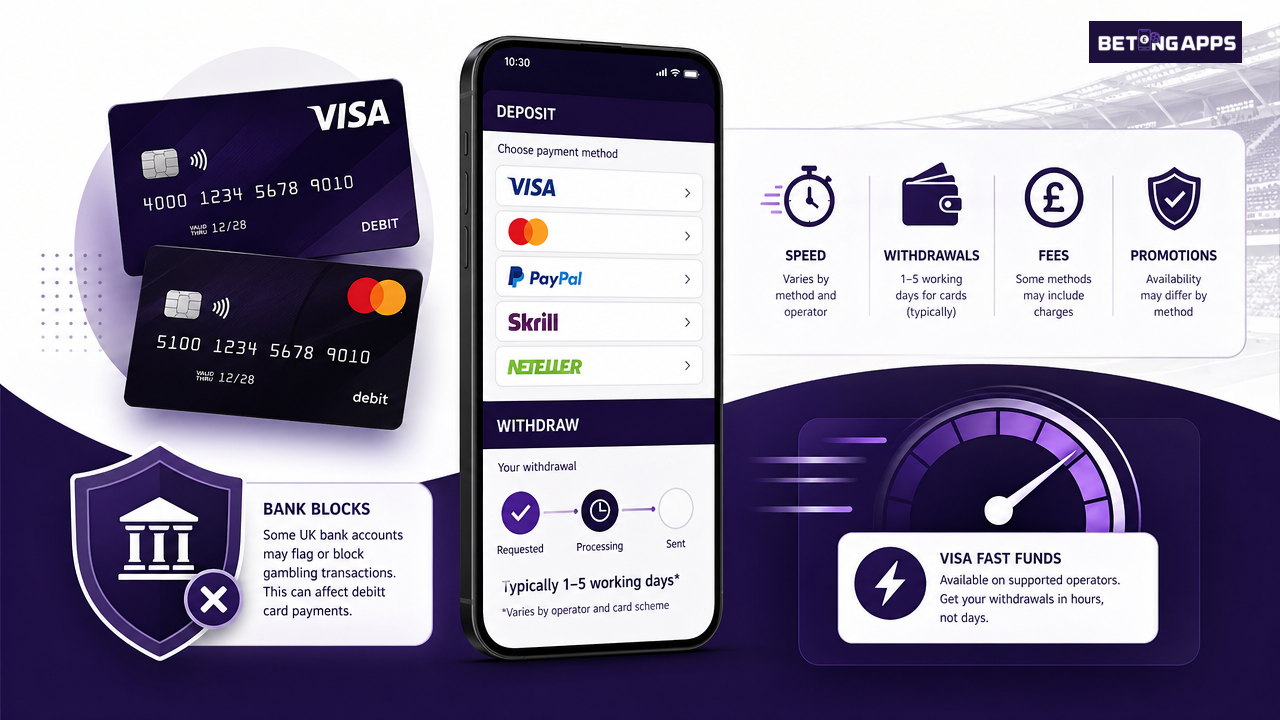
Visa and Mastercard debit cards remain the default for most UK punters, and for good reason. Deposits are instant. Withdrawals typically take one to five working days, governed partly by the operator’s internal approval queue and partly by card scheme settlement times. Visa Fast Funds can speed this up on supported operators, sometimes delivering funds within hours rather than days.
One issue that trips people up: some UK bank accounts flag or block gambling transactions at the issuer level, even on debit cards. If your deposit gets declined, do not assume your betting account has a problem. It may mean your bank has a gambling block enabled, either by default or because you activated one previously.
Check your banking app first.
E-Wallets: PayPal, Skrill, and Neteller
E-wallets sit between your bank and the bookmaker, so the operator never sees your card number directly. PayPal is the most widely recognised option among UK bettors, though Skrill and Neteller still appear across multiple UKGC-licensed apps.
E-wallet withdrawals are typically the fastest route available. After the operator approves the payout, funds often arrive within minutes to 24 hours.
The catch is significant, though: some operators exclude e-wallet deposits from welcome offers. If you plan to claim a sign-up bonus, check the terms before depositing via PayPal or Skrill. A non-qualifying deposit method usually disqualifies the entire offer with no way to reverse it.
For a closer look at which operators support PayPal for both deposits and withdrawals, see the PayPal betting apps guide. If Neteller is your preferred wallet, the Neteller betting apps page covers operator-specific availability.
Bank Transfers and Open Banking
Bank transfers handle larger deposits comfortably but process more slowly than cards or wallets. Standard transfers can take a working day to credit. Open Banking payments, which connect directly to your bank via a secure API, speed this up and avoid card-related declines entirely.
Operators tend to apply source-of-funds checks more aggressively on high-value bank deposits. If you deposit a large sum by bank transfer, expect a document request before the balance becomes fully usable.
This is not optional, and it can hold up your account until resolved.
Apple Pay and Google Pay
Mobile wallets offer tap-and-go deposits. The experience is genuinely fast: authenticate with Face ID or fingerprint, and the funds appear in your betting account within seconds. For getting money in, it does not get much smoother.
The limitation sits firmly on the withdrawal side. Most operators cannot send money back to Apple Pay or Google Pay directly. Instead, funds route to the card linked behind the wallet, or the bookmaker asks for separate bank transfer details.
This makes Apple Pay and Google Pay practical for deposits but noticeably less convenient when withdrawal speed is your priority. The extra step of confirming an alternative payout method can add time to your first cash-out.
Deposit and Withdrawal Speeds Compared
Speed is one of the clearest differentiators between payment methods. Every operator processes deposits near-instantly regardless of method, but withdrawal timelines diverge sharply.
| Method | Typical Deposit Speed | Typical Withdrawal Speed |
|---|---|---|
| Visa / Mastercard debit | Instant | 1-5 working days |
| Bank transfer | Minutes to 1 working day | 1-3 working days |
| PayPal / Skrill / Neteller | Instant | Minutes to 24 hours |
| Apple Pay / Google Pay | Instant | Returned to linked card: 1-5 working days |
E-wallets consistently outperform other methods on withdrawal delivery after the operator hits approve. Card withdrawals sit at the other end, constrained by banking settlement cycles the bookmaker cannot control.
What “Instant Withdrawal” Actually Means
When a betting app advertises instant withdrawals, take that with a degree of scepticism. It usually refers to the operator’s approval speed, not end-to-end delivery. The bookmaker may approve within minutes, but the payment network still applies its own processing window.
First-time withdrawals take longer regardless, because identity verification must complete before approval even begins.
For a breakdown of which operators genuinely process cash-outs fastest, the instant withdrawal betting apps page ranks apps by real-world payout speed across different methods.
Payment Limits and Fees
Limits and fees come from two directions: the operator and the payment provider. Both can cause problems independently, and they stack.
Deposit Limits
Minimum deposits range from £5 to £10 on most UK apps, though some methods carry higher floors. Maximum deposits vary by method, and operators may apply separate daily or weekly caps.
Any responsible gambling deposit limits you set override the method’s technical maximum, which is the intended behaviour under UKGC rules.
Withdrawal Limits and Staged Payouts
Per-transaction withdrawal caps mean large wins get paid in stages. A £10,000 win with a £2,000 per-transaction limit means five separate withdrawal requests, each potentially triggering its own approval cycle. Some operators also apply monthly withdrawal ceilings, particularly on promotional winnings.
Check these caps before depositing, not after winning. Discovering a payout ceiling after you have already placed your bets changes nothing except your level of frustration.
Who Charges Fees
Most UK bookmakers list deposits as fee-free, but the picture is less clean on withdrawals and at the provider level. Potential fee sources include:
- Skrill and Neteller dormancy fees on inactive accounts
- Some banks treating gambling deposits as quasi-cash advances on certain card products, attracting higher interest or transaction fees even on debit
- Currency conversion charges if your e-wallet holds a non-GBP balance
The operator’s cashier page should disclose its own fees before you confirm, but third-party charges sit outside that disclosure. You will not see them until your bank statement arrives.
Security and Payment Protection
UKGC-licensed apps are required to meet specific standards for handling your money and personal data. Understanding these protections helps you verify whether an operator is meeting its obligations.
Encryption and Secure Processing
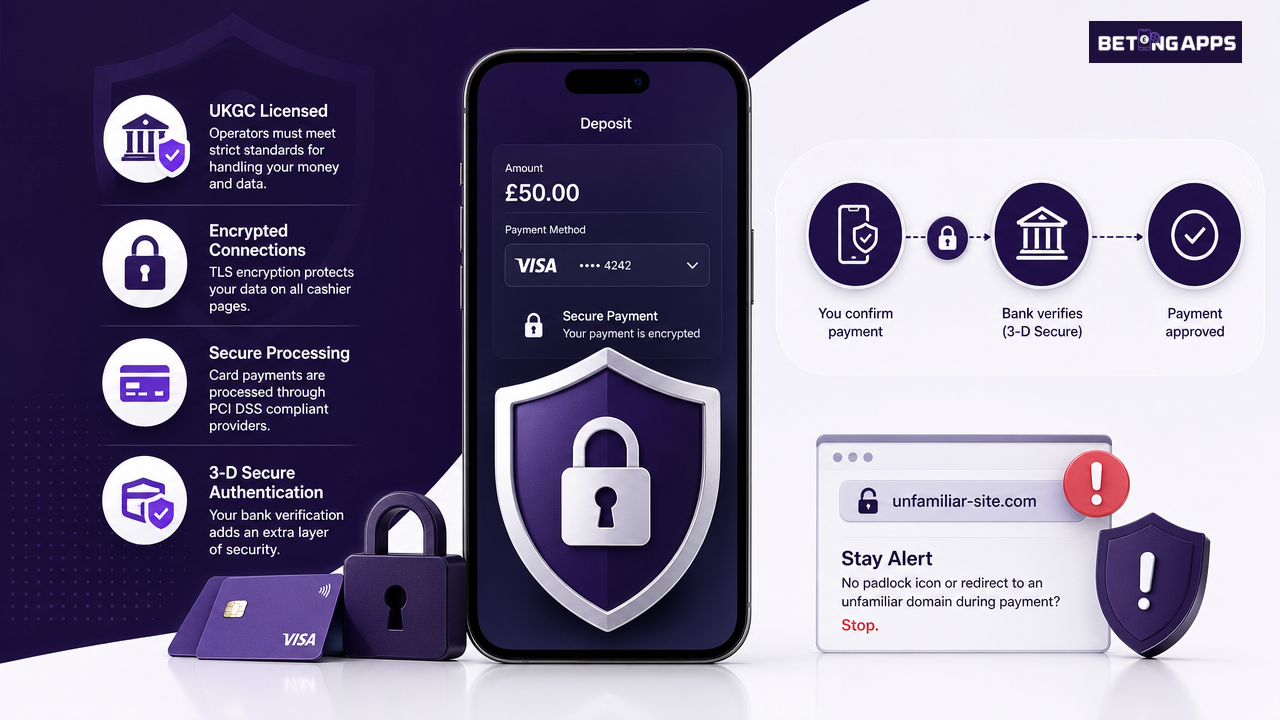
UKGC-licensed apps use TLS encryption on all cashier pages and process card payments through PCI DSS-compliant gateways. 3-D Secure authentication (the step where your bank asks you to confirm the payment via app or SMS code) adds a layer of protection against unauthorised card use.
If the cashier page lacks a padlock icon or redirects to an unfamiliar domain during payment, stop. Do not enter card details on a page that does not look right.
Two-Step Verification and Device Alerts
Most operators now offer or require two-step verification for logins and withdrawal requests. Common options include:
- SMS codes sent to your registered mobile number
- Authenticator apps such as Google Authenticator for stronger protection
- Device-based alerts that flag logins from unfamiliar phones or browsers
Operators may pause withdrawals until a new device is confirmed, adding a layer of security that protects your balance.
Customer Funds Protection
UKGC rules require operators to declare how they protect customer balances, categorised as basic, medium, or high. The protection level determines what happens to your money if the operator becomes insolvent. Basic protection offers the least security, and funds may not be ring-fenced at all.
This information sits in the operator’s terms, and checking it before depositing a significant balance is worth the two minutes it takes. If you are holding a large balance with an operator, you want to know what “basic” actually means for your money.
Responsible Gambling and Payment Controls
Payment method selection and responsible gambling are more closely connected than most guides acknowledge. The speed and ease of depositing directly affect impulse control, and the tools available depend on both the bookmaker and the bank.
Deposit Limits and Cooling-Off Periods
Every UKGC-licensed app lets you set deposit limits on a daily, weekly, or monthly basis. Reductions take effect immediately. Increases come with a mandatory delay, usually 24 hours or more, specifically to prevent impulsive reversals during a losing run.
This asymmetry is deliberate, and it works. If you have not set a deposit limit yet, do it now. You can always adjust it later, but having one in place creates a useful pause before any deposit that would push you past your budget.
Bank-Level Gambling Blocks
Major UK banks offer in-app gambling transaction blocks that operate at the merchant category level, blocking deposits to any gambling operator regardless of the betting app’s own controls. Banks offering this feature include:
- Monzo
- Starling
- Barclays
- Lloyds
Activating a bank block adds a layer of friction that sits outside the bookmaker’s influence. Some bettors find this more effective than app-level limits alone, precisely because it is harder to override in the moment.
Self-Exclusion and Payment Access
During a self-exclusion period, whether through an individual operator or the GamStop national scheme, deposit attempts are declined even if your card or wallet technically works. Withdrawal of existing balances may still be possible depending on the operator, but new deposits are blocked for the duration of the exclusion.
Self-exclusion is designed to provide a firm barrier, and the payment restrictions are a core part of how it functions.
Payment Methods and Promotional Offers
The payment method you use for your first deposit can determine whether you qualify for a welcome offer. This is one of the most common sources of frustration for new users, and the restriction is often buried in the terms rather than displayed prominently on the sign-up page.
Which Methods Qualify for Offers
Not all payment methods are treated equally when it comes to promotional eligibility. Here is a general overview:
| Payment Method | Typical Offer Eligibility |
|---|---|
| Debit cards (Visa/Mastercard) | Almost always qualify |
| PayPal | Qualifies on some operators but not all |
| Apple Pay / Google Pay | Inconsistent eligibility |
| Prepaid cards / Paysafecard | Frequently excluded |
| Bank transfers | Sometimes eligible, varies by operator |
If you are comparing free bet offers, confirm the eligible deposit methods before funding your account. Depositing with a non-qualifying method typically voids the offer permanently, with no option to re-trigger it by depositing again with a different method.
Withdrawal Rules on Bonus Winnings
Free bet winnings usually exclude the stake, so only profit becomes withdrawable. Bonus funds require wagering completion before conversion to cash, and most operators cap the maximum withdrawal from bonus play.
Be careful here: attempting to withdraw before wagering completes can forfeit the bonus entirely, not just pause it. Know where you stand with wagering requirements before hitting the withdrawal button.
Common Payment Issues and How to Avoid Them
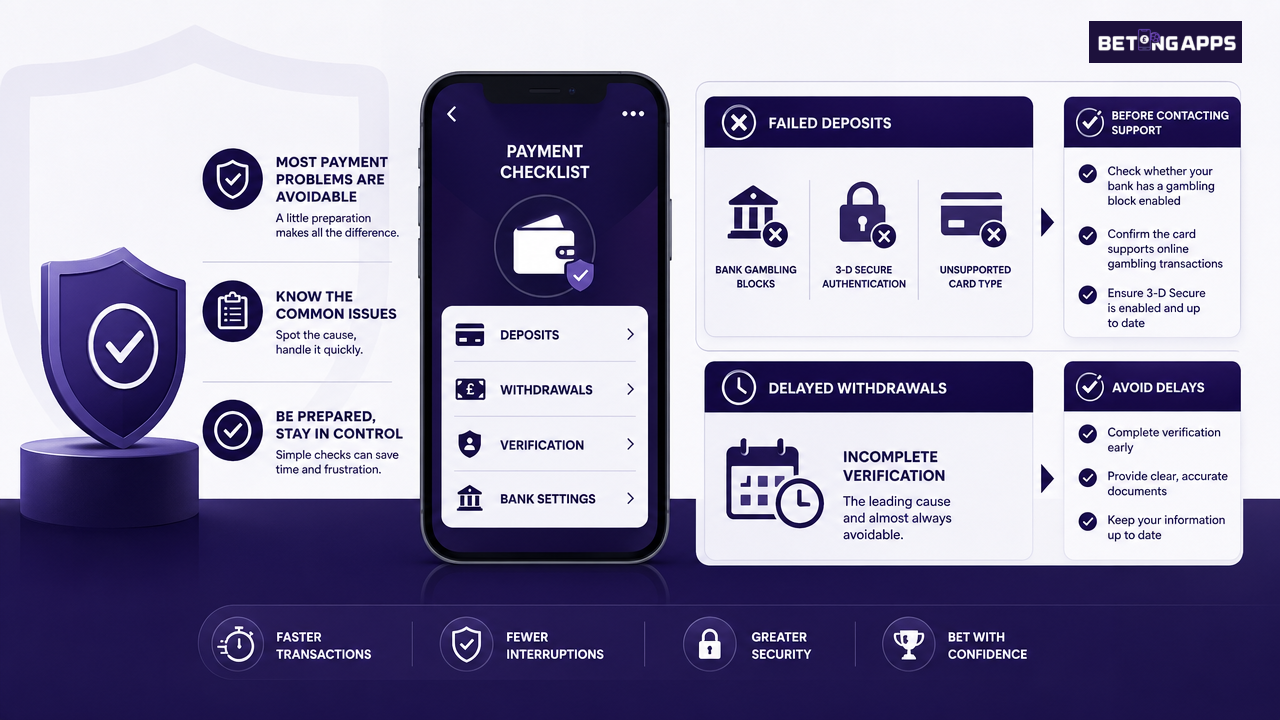
Most payment problems on UK betting apps are avoidable with a little preparation. Here are the issues that come up most often and how to handle them.
Failed Deposits
The most frequent causes are bank gambling blocks, failed 3-D Secure authentication, or using a card type the operator does not accept. Before contacting customer support:
- Check whether your bank has a gambling block enabled
- Confirm the card supports online gambling transactions
- Retry once after completing any banking app approval prompt
Most failed deposits resolve without operator involvement.
Delayed Withdrawals
Incomplete verification is the leading cause, and it is almost always avoidable. To prevent delays:
- Upload documents early
- Ensure name consistency across your betting account and payment method
- Avoid changing personal details mid-withdrawal
Operators also delay payouts when bonus wagering requirements remain incomplete or when open bets tie up part of the balance. If your withdrawal has been pending for more than the stated timeframe with no explanation, contact support directly.
Bonus Restrictions Blocking Cash-Outs
If the withdrawable balance shows less than expected, check whether bonus funds or pending wagering requirements are reducing it. Opting into a promotion just before requesting a withdrawal can inadvertently lock funds until the wagering clears.
Settle or cash out eligible bets first, and avoid activating new offers when a withdrawal is imminent. The timing matters more than people realise.
Are Payment Methods Safe on UK Betting Apps?
On UKGC-licensed apps, payment methods are regulated and subject to enforcement. The operator must use licensed payment processors, display accurate company and licensing details, and provide formal complaints routes including access to Alternative Dispute Resolution.
Verifying an Operator’s Licence
Cross-check the licence number shown on the app or website against the UKGC public register. Key things to look for:
- The company name at checkout should match the licensed entity
- Licence details should be clearly displayed and verifiable
- Mismatched names, missing licence details, or pressure to use cryptocurrency-only payments are warning signs of unlicensed operations
If something does not match, do not deposit. For a broader editorial view of how individual operators compare on licensing, payments, and overall trust, the review section goes beyond the basic register check.
Dispute and Chargeback Routes
Card payments carry chargeback rights through the issuer, though gambling transactions face tighter acceptance criteria than standard retail purchases. E-wallet disputes go through the wallet provider.
UKGC-licensed operators must offer an internal complaints procedure and, if unresolved, direct you to an approved ADR body. Keep transaction receipts and screenshots of cashier terms, as they strengthen any dispute considerably.
Frequently Asked Questions
Why can’t I use a credit card to deposit on a UK betting app?
The UKGC banned credit card gambling deposits in April 2020 to reduce harm linked to betting with borrowed money. The ban covers all UKGC-licensed gambling products and extends to credit-linked payment methods that function similarly to credit cards at checkout.
How long does a first withdrawal from a betting app take?
First withdrawals almost always take longer than subsequent ones because identity, age, and payment verification must complete before the operator approves the payout. Expect one to three additional working days on top of the standard method processing time. Submitting ID and proof of address before requesting your first cash-out reduces this delay significantly.
Do all betting apps accept PayPal for withdrawals?
No. PayPal availability for withdrawals varies by operator and sometimes by product within the same app. Some bookmakers accept PayPal deposits but route withdrawals to an alternative method. Check the cashier’s withdrawal options, not just the deposit screen, before funding your account via PayPal. The PayPal betting apps guide lists operators that support PayPal in both directions.

Joe Kizlauskas is an experienced iGaming writer with over a decade of industry experience covering betting apps, bookmakers, and online gambling products in the UK market. His work focuses on how betting apps operate in practice, including market coverage, app performance, payments, and regulatory standards.
Alongside his professional background in iGaming, Joe has extensive first hand exposure to the sports covered on this site. He played football for more than 30 years and has regularly attended horse racing events, giving him a practical understanding of how betting markets relate to real sporting contexts.
This combination of industry knowledge and sporting experience informs the analysis on BettingApps.uk.com. All content is written with a focus on clarity, accuracy, and UK regulation, ensuring comparisons are grounded in how betting apps function rather than promotional claims.