
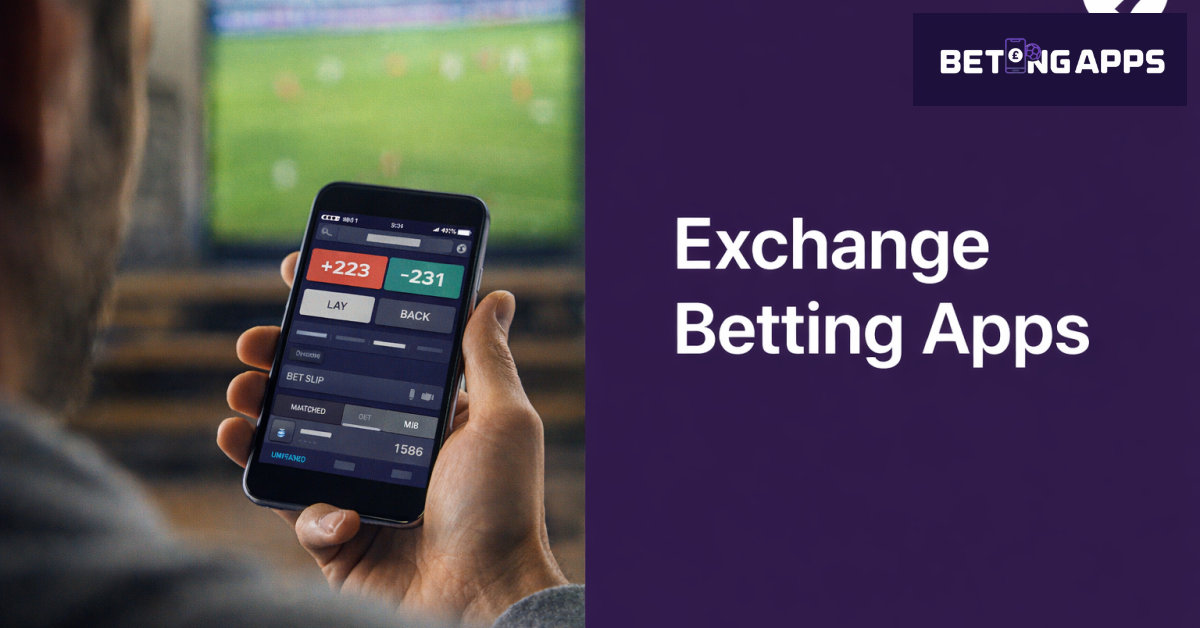
Exchange betting apps provide access to betting exchanges, where you place bets against other users rather than against a bookmaker. A betting exchange uses a market of back and lay prices, and the operator matches bets and charges commission on net winnings. Exchange betting apps suit bettors who want to compare live prices, place lay bets, or trade positions during an event.
UK bettors need to understand how exchange betting differs from standard bookmaker betting because the risks, costs, and bet settlement rules change. Liquidity affects whether a bet matches at the requested price, commission affects returns, and lay betting creates liability that exceeds the stake. Exchange betting apps also sit within UK gambling rules on age verification, safer gambling controls, and identity checks, which affects how quickly full account features become available.
Exchange Betting Apps Explained
Exchange betting apps provide access to betting exchanges where you place bets against other customers rather than against a bookmaker. Exchange betting suits odds comparison, in-play betting, and strategies such as laying or trading, but the outcome depends on available liquidity and the exchange commission rate.
Exchange betting app rules and pricing differ from a bookmaker app. Understanding how exchanges match bets, how prices move, and what common terms mean reduces errors, especially when using lay bets or placing orders in fast-moving in-play markets.
What Is A Betting Exchange?
A betting exchange is a betting service that matches customers who want to back an outcome with customers who want to lay the same outcome. The exchange provides the market, matches bets, and charges commission on net winnings on settled markets.
A betting exchange market lists outcomes with prices and available stakes at each price. A bet matches instantly when another customer offers the opposite side at the same price. Unmatched bets remain as orders until they match, get cancelled, or the market suspends.
How Exchange Betting Differs From A Bookmaker App
A bookmaker app sets odds and takes the other side of your bet. A betting exchange app lists customer-driven prices and matches your bet with another customer’s opposing position. The exchange does not price the market in the same way as a bookmaker, but exchange prices still move based on demand and supply.
A betting exchange app also handles risk differently for lay betting. A lay bet requires sufficient funds to cover liability, which is the amount lost if the selection wins. A bookmaker app usually only requires the stake up front and does not offer lay bets as a standard market feature.
Back Bets, Lay Bets, And Trading Terms
A back bet is a bet that an outcome happens, such as a team to win. A lay bet is a bet that an outcome does not happen, such as laying a team so you profit if the team draws or loses. A lay bet creates liability, calculated as (lay odds minus 1) multiplied by the lay stake.
Exchange betting apps also use trading-style terms because prices move and positions can be opened and closed. Common terms include:
- Stake: the amount risked on a back bet, or the amount won from a customer you lay if the selection loses.
- Liability: the amount risked on a lay bet if the selection wins.
- Commission: a fee charged by the exchange on net winnings on a settled market.
- Matched: the portion of an order that another customer accepts.
- Unmatched: the portion of an order still waiting to match at the chosen price.
- Cash out: a feature that closes a position using the current exchange prices, subject to available liquidity and fees.
- In-play: a market that remains open after an event starts, with prices changing quickly.
Clear use of stake and liability reduces accidental overexposure, especially when placing lay bets at shorter odds where liability rises quickly.
How Exchange Prices And Liquidity Work
Exchange prices work by order matching. Each outcome shows available back and lay prices, with amounts waiting at each price. A price only becomes available to you when another customer offers it, so the best price and the amount available change as orders enter and leave the market.
Liquidity is the amount of money available to match at the listed prices. Low liquidity often leads to partial matches, wider gaps between back and lay prices, and more price movement after a stake enters the market. Higher liquidity usually supports larger stakes, faster matching, and tighter spreads, which matters most in in-play markets where suspension and rapid price changes are common.
How Exchange Betting Apps Work
Exchange betting apps match your bet against another customer’s bet, instead of pricing the bet against a bookmaker’s risk. The app displays available odds in a market, and your bet either matches instantly or sits as an order until another customer accepts it. Exchange betting uses back bets (betting for an outcome) and lay bets (betting against an outcome), with commission typically charged on net winnings in a market.
UK-facing exchange betting apps also apply identity and affordability-related checks under licence conditions. The process affects how quickly you can deposit, withdraw, and place certain bets, especially on higher-risk or higher-value activity.
Account Setup, Verification, And KYC Checks
Account setup follows a standard operator registration flow, including personal details and contact verification. Exchange betting apps also require identity checks to meet Know Your Customer (KYC) and anti-money laundering rules. Verification often uses document upload or electronic checks against credit reference and identity databases.
Common KYC checks include:
- Name, date of birth, and address matching
- Photo ID verification, such as a passport or driving licence
- Proof of address, such as a bank statement or utility bill
- Payment method ownership checks when details do not match account information
KYC status affects account functionality. Some operators restrict withdrawals, deposit limits, or betting until verification completes.
Deposits, Withdrawals, And Wallet Options
Exchange betting apps use an account wallet to hold funds for betting, liability, and withdrawals. Deposits add available balance, while open bets and lay liability reduce available funds until markets settle or orders cancel. Some operators separate “available” and “reserved” balances to show what remains usable.
Key wallet behaviours to understand include:
- Lay bets reserve liability, not just the stake
- Unmatched orders often reserve stake or liability until cancellation
- Withdrawals often return to the original deposit method where possible
- Additional checks often apply before large or unusual withdrawals
Processing times vary by payment method and operator controls. Faster Payments usually settles quicker than card withdrawals, while some e-wallets process quickly once account checks clear.
Placing A Back Bet Step By Step
A back bet supports an outcome, such as a team to win. The back bet stake is the amount risked, and the potential profit depends on the matched odds.
A typical back bet flow looks like this:
- Select a market and outcome.
- Choose “Back” odds shown in the market.
- Enter the stake.
- Review estimated returns based on the odds.
- Confirm the bet.
- Check whether the bet matches fully, matches partially, or stays unmatched.
Settlement follows the market result. A matched back bet returns the stake plus profit if the outcome occurs, and loses the stake if the outcome does not occur.
Placing A Lay Bet Step By Step
A lay bet opposes an outcome, meaning the bet wins if the outcome does not happen. A lay bet includes a stake that you stand to win from the other customer, and a liability that you pay if the outcome happens.
A typical lay bet flow looks like this:
- Select a market and outcome.
- Choose “Lay” odds shown in the market.
- Enter the lay stake (the amount you aim to win, before commission).
- Review the liability shown by the app.
- Confirm the bet.
- Check whether the lay bet matches fully, matches partially, or stays unmatched.
Liability depends on odds and stake. Higher odds create higher liability for the same lay stake, and the app reserves that liability from the wallet until settlement or cancellation.
Order Types, Partial Matches, And Unmatched Bets
Exchange betting apps work like an order book. Available odds reflect existing customer orders, and your bet either takes those odds or adds a new order at your chosen price. Market movement changes whether the order matches quickly.
Common matching outcomes include:
- Full match, where the full stake or liability matches immediately
- Partial match, where part matches and the remainder stays open
- Unmatched, where the full order remains open until odds become available or the order is cancelled
Unmatched bets carry practical risks. Price movement can leave an order unmatched until market start, and an unmatched order can reduce available balance if funds stay reserved. Apps typically provide controls to cancel, amend odds, or reduce stake to manage exposure.
Cash Out Versus Trading Out
Cash out is an operator feature that offers a single action to close a position at a quoted price. Cash out availability depends on market liquidity, event status, and operator rules. Cash out prices include a margin and can change quickly, especially during in-play periods.
Trading out uses manual exchange bets to lock in a profit or reduce a loss by placing an opposite bet. A back position trades out by laying the same selection, and a lay position trades out by backing the same selection. Trading out relies on available odds and matching, so execution risk exists when liquidity is low or odds move fast.
Cash out prioritises convenience, while trading out prioritises control over price and stake. The choice affects cost and certainty, especially when unmatched orders or partial matches occur.
Costs And Charges On Exchange Betting Apps
Exchange betting apps usually charge for the service through commission and, in some cases, additional account-level fees. These charges affect your effective odds and your long-term returns, especially if trading frequently or operating at high volume.
The main cost types are commission on net winnings, premium charges for some high-performing accounts, and smaller operational fees. Understanding how each charge applies helps you compare exchange prices with bookmaker odds on a like-for-like basis.
Commission On Net Winnings
Commission is a percentage charge applied to net winnings, not to stakes. Commission rates vary by exchange and sometimes by market or customer segment. The exchange calculates your gross profit from settled bets and then deducts commission from the profit figure.
Commission usually applies per market. A net loss in a market typically results in no commission for that market, even if other markets settle as winners. The commission deduction reduces the payout on winning outcomes, so the “true” price received is slightly worse than the headline exchange odds.
Checks that clarify commission impact include:
- The standard commission rate shown in the account or market information
- Whether commission applies per market, per event, or across a time period
- Whether commission rates change by sport, market type, or liquidity tier
Commission matters most when taking small edges repeatedly, because the percentage charge removes part of each win.
Premium Charges And Other Fees
Some exchanges apply premium charges to a small set of accounts, usually based on a combination of profitability and commission generated. Premium charges increase the effective cost of betting beyond the standard commission rate. The exact trigger conditions and calculation method vary by operator and are set out in the exchange rules.
Other fees sometimes appear outside core betting activity. Examples include fees linked to currency conversion, certain payment methods, or administrative processes. A fee may also apply when using features that rely on additional services, depending on the operator’s terms. Fee schedules change, so the account “Fees and Charges” page and the exchange rules provide the most reliable detail.
Premium and ancillary fees affect the net return, so the practical comparison needs to use post-fee figures rather than headline prices.
How Fees Affect Value Compared With Bookmaker Margins
Bookmakers build costs and profit into the odds through an overround, also called the margin. Exchange betting apps present prices set by the market, then apply commission and any additional charges. The result is that the best value depends on both the available odds and the fee structure for your account.
A simple comparison uses effective odds after commission. Higher exchange odds do not always beat a bookmaker price once commission applies, and a lower exchange odds line sometimes still delivers better value if the bookmaker margin is high. Account-specific charges, such as premium fees, further narrow the gap and sometimes reverse it on markets with small differences.
Costs and charges determine the net price you receive, so fee-aware comparisons give a more accurate view of exchange value versus bookmaker margins.
Key Features To Compare In Exchange Betting Apps
Exchange betting apps differ most in market access, how quickly bets reach the exchange, and the tools available for managing risk once a bet is matched. Comparing features side by side helps you judge whether an app suits your betting style, such as pre-match value betting, in-play trading, or occasional hedging across markets. Account for UK-specific frictions such as in-play bet delays and the practical impact of liquidity on getting matched at the price shown.
Market Coverage And Depth
Market coverage describes which sports, leagues, and bet types an exchange lists, plus how often markets appear ahead of an event. Market depth describes how much money is available to back and lay at each price, which affects slippage and the chance of partial matches.
Compare market coverage using checks that relate to how bets get matched:
- Availability of the sports and competitions used most often
- Range of market types, such as match odds, over or under, correct score, and player markets (where offered)
- Pre-match time horizon, such as whether markets appear days in advance or only close to kick-off
- Liquidity at common stake sizes, measured by money available at the best prices and one or two ticks away
Shallow markets raise the chance of worse average prices, partial fills, and longer time to get matched, especially on lower-league events.
In-Play Betting And Bet Delay Rules
In-play betting uses live markets where prices move quickly and the exchange applies a bet delay before an unmatched bet reaches the market. Bet delay length varies by sport and event type, and it directly affects strategies that rely on fast execution.
Compare in-play features that influence execution speed and control:
- Bet delay display and whether the app shows a countdown clearly
- In-play market refresh rate and how often prices update on the screen
- Behaviour during suspensions, such as goals, penalties, red cards, or VAR
- Controls for cancelling or editing unmatched bets during the delay window (if supported)
Longer or less transparent delays increase the risk of chasing price moves and getting matched after the edge disappears.
Price Format, Tick Sizes, And Bet Slips
Price format affects readability, while tick sizes define the minimum odds movement between adjacent prices. Tick size differences matter most when trading in tight ranges, because one tick equals the smallest possible improvement or deterioration in price.
Compare price and bet slip handling with practical checks:
- Supported price formats, such as decimal and fractional
- Visibility of available prices and amounts for both back and lay
- Clear separation of back and lay stake fields, including liability display for lay bets
- Default stake, one-tap stake buttons, and confirmation steps that reduce input errors
- Handling of partial matches, including whether the app shows average matched odds and remaining unmatched stakes
A bet slip that shows lay liability prominently reduces the risk of placing a larger exposure than intended.
Cash Out Tools, Hedging, And Trading Interfaces
Cash out features vary by exchange and by market liquidity, and cash out availability often changes during volatile in-play periods. Hedging tools help lock in profit or reduce loss by placing the opposite bet at a new price, which relies on clear matched and unmatched bet reporting.
Compare trade management tools that affect decision-making:
- Cash out availability by sport and market, plus how the app presents the cash out price
- Manual hedge calculators or profit and loss projections across outcomes
- Order management, including cancel, amend, and keep or cancel settings where available
- Market ladder, one-click trading, or advanced views for faster entry and exit (if provided)
Tool quality matters most when prices move quickly and market depth changes, because delayed exits often turn manageable exposure into larger variance.
Odds Alerts, Streaming, And Data Add-Ons
Alerts and data add-ons affect how quickly you react to price moves without watching the market constantly. Streaming and in-app stats vary widely and often depend on rights, region, and event tier.
Compare add-ons that improve monitoring without adding friction:
- Odds alerts for specific prices, movements, or matched status
- Notifications for market suspensions, event start, or significant price changes
- Live streaming availability and device compatibility where offered
- In-app scores, timers, and basic event stats, plus clarity on update frequency
Data that updates slowly or inconsistently increases the risk of trading on stale information, especially during in-play swings.
App Performance, Stability, And Connectivity
Performance affects whether prices load correctly, bets submit without errors, and order status updates promptly. Stability matters most during high-traffic events when exchanges experience peak load and rapid market moves.
Compare performance using observable checks during normal and peak times:
- Login reliability, including biometric login support and session timeouts
- Speed of market loading and price refresh under mobile data and Wi‑Fi
- Bet submission feedback, including clear pending, unmatched, and matched states
- Error handling that explains failures, such as insufficient funds, market suspension, or connectivity loss
- Background behaviour, such as whether alerts and market updates continue reliably when switching apps
A stable app with clear order states reduces execution mistakes and helps maintain control over unmatched exposure during fast markets.
Risks And Common Mistakes With Exchange Betting Apps
Exchange betting apps add extra risk points compared with standard bookmaker betting because prices move, markets vary in depth, and profits reduce by commission. Risk also changes by bet type, especially when laying selections where potential losses exceed the stake.
Common mistakes come from treating exchange bets like fixed-odds bets, placing orders without checking market depth, and misreading in-play rules. Understanding liability, execution, and settlement rules helps avoid avoidable losses and disputes.
Liability On Lay Bets And Bankroll Planning
Lay betting creates liability, not just a stake. A lay bet risks paying out the backer if the selection wins, so the potential loss often exceeds the amount shown as the lay stake.
Check liability before placing the order and link it to bankroll limits. Common errors include laying short prices without realising the liability size, and placing multiple lay bets that share correlated outcomes. Use practical checks such as:
- Confirm the app displays “liability” separately from “stake” before confirming the bet.
- Calculate worst-case exposure across all open markets, not per bet.
- Avoid using the full available balance as available margin for new lay orders.
Bankroll planning also includes controlling unmatched orders. An unmatched lay can match later at a worse price than intended if the market moves, which changes the liability and risk profile.
Slippage, Thin Markets, And Price Movement
Slippage happens when the requested odds are no longer available when the bet matches. Exchange markets rely on other users’ orders, so the available price and volume can change quickly, especially in lower-liquidity events.
Thin markets increase the chance of partial matching, delayed matching, and worse effective odds. Price movement also affects strategies that rely on precise entry points. Key checks include:
- Check the available amount at the chosen odds before placing the bet.
- Use exchange order options such as setting a specific price rather than taking the current best price.
- Review whether the app shows estimated matching or market depth indicators.
Price movement matters more close to the start time and during major news. A matched bet at a different price changes implied probability and expected return.
In-Play Timing, Suspension, And Market Voids
In-play markets suspend frequently around key moments such as kick-off, goals, penalties, and video review decisions. Suspensions protect market integrity but create execution risk if an order is queued and matches immediately after re-opening at a different price.
Timing issues also appear due to feed delays and device latency. Exchange rules, the event data source used for in-play, and market status changes affect whether a bet matches, remains unmatched, or is cancelled. Practical checks include:
- Confirm the market status shows “in-play” before relying on live prices.
- Cancel unmatched orders when the market turns in-play if the pre-match price no longer fits the plan.
- Read the operator’s market rules for voids, late goals, abandoned matches, and settlement timing.
Void and cancellation rules differ by sport and market type. A misunderstanding about what counts as a “runner”, “participant”, or “non-runner” leads to unexpected settlements.
Misunderstanding Commission And Profit Calculations
Exchange commission reduces net winnings, not gross returns, and the rate varies by operator and account status. Commission also affects hedged positions, where a back and lay trade shows a profit before fees but a smaller figure after commission.
Profit calculations differ between back and lay bets. A back bet profit equals stake multiplied by (odds minus 1) before commission. A lay bet profit equals the backer’s stake received if the selection loses, while the liability applies if the selection wins. Common mistakes include:
- Comparing exchange odds to bookmaker odds without factoring in commission.
- Assuming the displayed “potential profit” already includes commission in all cases.
- Forgetting commission when calculating equal profit outcomes in a trade.
Accurate net profit checks keep expectations realistic and reduce errors when placing hedges, cashing out manually, or scaling stakes across multiple markets.
UK Rules And Safer Gambling For Exchange Betting Apps
UK exchange betting apps operate under gambling regulation that focuses on fair play, customer protection, and harm prevention. A UK Gambling Commission (UKGC) licence is the key baseline, because the licence conditions set rules on how an operator handles your money, your data, and your ability to control gambling.
Safer gambling tools and compliance checks affect everyday use, including when account access starts, how quickly you withdraw, and what happens if a transaction or settlement is disputed. UKGC requirements also shape how an exchange identifies customers and manages higher risk behaviour.
UKGC Licensing And Consumer Protections
A UKGC-licensed betting exchange follows Licence Conditions and Codes of Practice (LCCP). UKGC oversight links to how the operator segregates and safeguards customer funds, how it markets to customers, and how it handles complaints.
UKGC-licensed exchange betting apps also apply rules on market integrity and transparent settlement. Exchange markets involve peer-to-peer matching, so clear rules on bet matching, market suspension, and voiding events reduce the risk of unfair outcomes.
Key checks to complete before using an exchange betting app include:
- Confirm the operator displays a UKGC licence number and a registered UK business entity.
- Check the site footer for UKGC licensing wording and links to safer gambling support.
- Review the operator’s rules on void bets, market suspension, and event settlement.
UKGC licensing does not remove all risk, but it provides enforceable standards and escalation routes if problems occur.
Age Verification And Identity Checks
Age verification blocks underage gambling and forms part of wider identity checks. Exchange betting apps use verification to confirm personal details, prevent fraud, and meet anti-money laundering and safer gambling duties.
Identity checks often include name, date of birth, address, and additional evidence if automated checks fail. Some operators restrict deposits, betting, or withdrawals until verification completes. Document requests often increase after changes to account details, unusual betting patterns, or higher value transactions.
Delays usually reduce when account details match official records. Accurate information at registration supports faster verification and fewer interruptions to withdrawals.
Deposit Limits, Time Outs, And Self Exclusion
Deposit limits cap the amount added to an account over a set period. Time-outs pause access for a short period. Self-exclusion blocks access for a longer fixed period and applies stricter return-to-play rules.
Exchange betting apps generally provide account tools that apply immediately, alongside options to block specific products or apply reality checks. Self-exclusion often links to broader schemes, including multi-operator exclusion, depending on the operator’s integration.
Warning signs that indicate safer gambling controls need tightening include:
- Regularly increasing deposit limits to maintain the same level of betting.
- Chasing losses after a run of losing markets.
- Spending longer sessions on in-play markets than planned.
Safer gambling controls work best when limits reflect disposable income and when breaks occur before gambling becomes habitual.
Dispute Processes And Record Keeping
Disputes on betting exchanges usually relate to settlement, market suspension, rule interpretation, or account restrictions. Operators provide a complaints process with set steps, and records support the investigation.
Account history matters on exchanges because evidence often sits in bet logs, matched and unmatched orders, and timestamps for suspensions or rule changes. Keeping copies of key records reduces friction if a complaint escalates, including screenshots of market rules, order confirmations, and communications.
A structured approach improves outcomes:
- Use the operator’s formal complaints channel rather than live chat for disputed settlement.
- Provide event name, market, selection, stake, odds, and time placed.
- Keep confirmation emails and transaction references for deposits and withdrawals.
Clear records and the operator’s documented rules set the basis for resolving exchange-specific disputes under UK consumer protection standards.
Practical Checks Before Using An Exchange Betting App [List]
Exchange betting apps match your bet against other users, so price quality, liquidity, and execution matter as much as odds. Checks also need to cover UK Gambling Commission licensing, account security, fees, and withdrawal processing, because each point affects cost, risk, and speed of access to funds.
Use the checks below before placing a first lay bet, using in-play features, or moving larger stakes through the app.
Licensing And Security Checks
- Confirm the operator holds a UK Gambling Commission licence and displays the licence details in-app or on the site footer.
- Check the app publisher name matches the licensed operator name, not an unrelated developer.
- Review sign-in options and enable strong authentication where available, such as biometrics or two-step verification.
- Check session controls, including device management and the ability to log out of other devices.
- Confirm the app uses encrypted connections, indicated by secure login and account areas.
- Check responsible gambling tools exist and work, including deposit limits, time-outs, and self-exclusion links.
Licensing and security checks reduce the risk of using an unregulated service and reduce the chance of account takeover.
Fee And Commission Checks
- Confirm how commission applies, including the commission rate and whether it charges on net winnings per market or another basis.
- Check whether different sports, markets, or customer tiers use different commission rates.
- Check for additional charges, including premium-style fees, data fees, or charges linked to high-volume or consistently profitable accounts.
- Check how the app rounds commission and whether minimum charges apply on small wins.
- Confirm whether fees apply when bets are cancelled, voided, or partially matched.
Fee checks clarify the true cost of trading and avoid surprises when comparing exchange prices to bookmaker odds.
Market And Liquidity Checks
- Check the range of sports and markets offered, including whether the app supports the specific leagues and bet types used most often.
- Check typical available money at key price points, especially near kick-off and during in-play, because liquidity affects matching speed.
- Compare back and lay spreads on common markets, because wide spreads increase trading cost.
- Check maximum stake visibility and whether the app shows unmatched amounts clearly.
- Check how the app handles market suspensions, in-play delays, and bet persistence options when markets turn in-play.
Liquidity checks improve execution and reduce the risk of being left with unmatched exposure at critical moments.
App Usability And Trading Tools Checks
- Check that the bet slip shows back versus lay clearly, including stake, liability, and projected profit and loss.
- Confirm the app supports cash out or trade-out tools if used, and verify whether the feature relies on available liquidity.
- Check order controls, including cancel, amend, partial match handling, and whether unmatched bets stay in the market.
- Check price presentation, including ladders, depth views, or simple lists, and confirm the view fits the intended trading style.
- Check in-play usability under time pressure, including market switching, one-tap actions, and clear suspension messaging.
- Check the app provides an account statement with bet history, matched prices, commission charged, and settled profit and loss.
Usability and tooling checks reduce input errors and support faster decisions when prices move quickly.
Payment And Withdrawal Speed Checks
- Check available payment methods for deposits and withdrawals, and confirm method-specific limits and verification requirements.
- Confirm identity checks happen before withdrawal where required, and prepare documents early to avoid delays.
- Check stated withdrawal processing times and whether the app processes withdrawals on weekends and bank holidays.
- Check whether the app applies different timelines for different methods, such as bank transfer versus debit card versus e-wallet.
- Review any fees for withdrawals, currency conversion, or inactive accounts if relevant to the account type.
- Check how the operator handles chargebacks, failed withdrawals, and returned payments, including support contact routes.
Payment checks reduce downtime between markets and improve certainty over when funds become available.
Exchange Betting App Use Cases
Exchange betting apps suit use cases where you need price control, the option to lay outcomes, and the ability to act quickly when odds move. Exchange markets often differ from bookmaker prices because exchange odds reflect available back and lay liquidity, minus commission on net winnings. Understanding common use cases helps you decide when an exchange bet fits the job and what risks apply.
Use cases often involve managing existing positions, reacting to live information, or using the exchange as a reference point for pricing. Execution quality depends on market liquidity, the size of the spread between back and lay odds, and whether orders get matched at the price requested. Exchange betting app use cases become practical when those conditions stay favourable.
Hedging A Bookmaker Bet With A Lay Bet
A lay bet on an exchange offsets a bookmaker back bet by creating an opposing position on the same selection. Hedging works by balancing outcomes so the potential loss narrows, or a profit locks in, across all results after both bets settle. The exact hedge stakes depend on the bookmaker odds taken, the current exchange lay odds, and the exchange commission rate.
A common approach uses a lay stake that targets either equal profit across outcomes or a defined maximum loss. Key checks before placing the lay bet include:
- The exchange lay price and available liquidity at that price
- The back to lay spread, because a wider spread increases hedging cost
- The commission rate, because commission reduces net winnings on the exchange side
- The bookmaker bet terms, because some bets settle differently (for example, each way places, void rules, or rule 4 deductions)
Partial matching changes hedge accuracy. A hedge also introduces timing risk if the exchange price moves before the lay bet matches or if the market suspends in play. Hedging remains a core exchange use case because lay bets provide direct outcome coverage rather than relying on cash out features.
Trading Pre Match To In Play
Pre match to in play trading uses price movement between the pre match market and the in play market to reduce risk or take profit without holding the original exposure to full time. Exchange betting apps support this by allowing you to place back and lay orders at different prices, either instantly at market prices or as unmatched orders waiting to be taken.
Price movement often happens because new information enters the market, such as team news, weather, or early match events. A typical trade flow uses one position pre match and an opposing position in play:
- Back pre match at higher odds and lay in play at lower odds if the selection shortens
- Lay pre match at lower odds and back in play at higher odds if the selection drifts
In play trading adds suspension risk. Football markets often suspend around key events, and odds can gap when the market reopens. Execution risk also increases in thin markets where liquidity falls and spreads widen. Pre match to in play trading remains relevant because exchange order control helps manage entry and exit prices when markets move quickly.
Using Exchange Markets For Price Discovery
Price discovery uses exchange odds as a reference for the market’s current view of probability. Exchange prices often react quickly because many participants set orders around the same information, and the traded volume gives context to where money actually matches. Price discovery helps you compare a bookmaker price with the exchange to assess whether the bookmaker line sits above or below the exchange consensus.
Price discovery works best when you check both sides of the exchange market, not only the best back price. The lay price, the spread, and available liquidity indicate whether the displayed back odds are actionable at your intended stake. Useful checks include:
- The best back and best lay prices, because the spread signals friction in the market
- Traded volume, because low volume makes the price less reliable for larger stakes
- Depth of money, because available amounts at each price show how far odds may move when you place a bet
- Timing, because prices near kick off or start time often change faster than earlier markets
Exchange prices do not remove bookmaker restrictions or change bookmaker settlement rules, but they provide a practical benchmark for assessing value. Price discovery remains a common use case because exchange markets translate supply and demand into transparent back and lay prices.
FAQs
Exchange betting apps use a betting exchange model, where bets match between customers rather than being set by a bookmaker. UK rules, exchange terminology, and matching mechanics affect what you pay, how bets settle, and why prices and availability change in an app. The FAQs below cover legality, core bet types, commission, settlement outcomes, and common reasons a bet does not match.
Are Exchange Betting Apps Legal In The UK?
Exchange betting apps are legal in the UK when the operator holds a licence from the Gambling Commission. A Gambling Commission licence indicates the operator meets UK requirements on customer protection, fairness, and anti-money laundering controls.
A non-UK-licensed exchange betting app still accepts UK traffic in some cases, but that position increases consumer risk. A UK-licensed operator provides access to UK dispute routes and responsible gambling tools such as deposit limits and self-exclusion.
What Is A Lay Bet In An Exchange Betting App?
A lay bet is a bet against an outcome. A lay bet works by offering odds to another customer who wants to back the same outcome.
A lay bet requires liability. Liability is the amount paid out if the selection wins. The exchange reserves that liability from available funds until the market settles or the bet cancels.
How Does Commission Work On Betting Exchanges?
Commission is a fee the exchange charges on net winnings for a market. Commission applies after settlement, and it normally does not apply to losing bets.
Commission affects effective odds. A higher commission rate reduces profit on winning bets, so comparing prices between exchanges needs a like-for-like check that includes commission.
What Happens If A Lay Bet Loses?
A lay bet loses when the selection wins. The exchange pays the matched backer from the layer’s reserved liability, and the layer loses the liability amount.
A lay bet wins when the selection loses. The layer keeps the backer’s stake as profit, minus any exchange commission on net winnings.
Do Exchange Betting Apps Offer Cash Out?
Some exchange betting apps offer cash out on selected markets. Cash out, when available, offers an early settlement price based on the current market and the operator’s cash-out terms.
Cash out availability depends on liquidity and market status. A suspended market or low liquidity often removes cash out or produces a less favourable cash-out price.
Why Do Some Bets Stay Unmatched?
Unmatched bets happen when no other customer accepts the offered odds for the stake size. Unmatched bets also happen when market liquidity is low or when the price moves away from the requested odds.
Common checks for unmatched bets include:
- The requested odds differ from the best available price.
- The stake size exceeds available liquidity at the requested odds.
- The market is suspended due to an incident, such as a goal or a red card.
- A time delay applies to in-play betting, and the price changes before matching.
Price and liquidity checks reduce unmatched time. A bet matches faster when the odds align with the available market and the stake fits the money waiting at that price.
Conclusion
Exchange betting apps give access to Peer-to-peer betting apps markets where you place bets against other customers, with the betting exchange taking commission on net winnings. Exchange pricing, order types, and liquidity affect the odds available and the speed of matching, so checking market depth and commission rates stays relevant for day-to-day betting decisions.
UK users get the clearest protections by using a UK Gambling Commission licensed operator, with clear terms on commission, withdrawals, and account verification. Exchange betting apps suit bettors who understand back and lay betting, accept variable availability by event, and prefer price-led markets over fixed-odds bookmaker pricing.